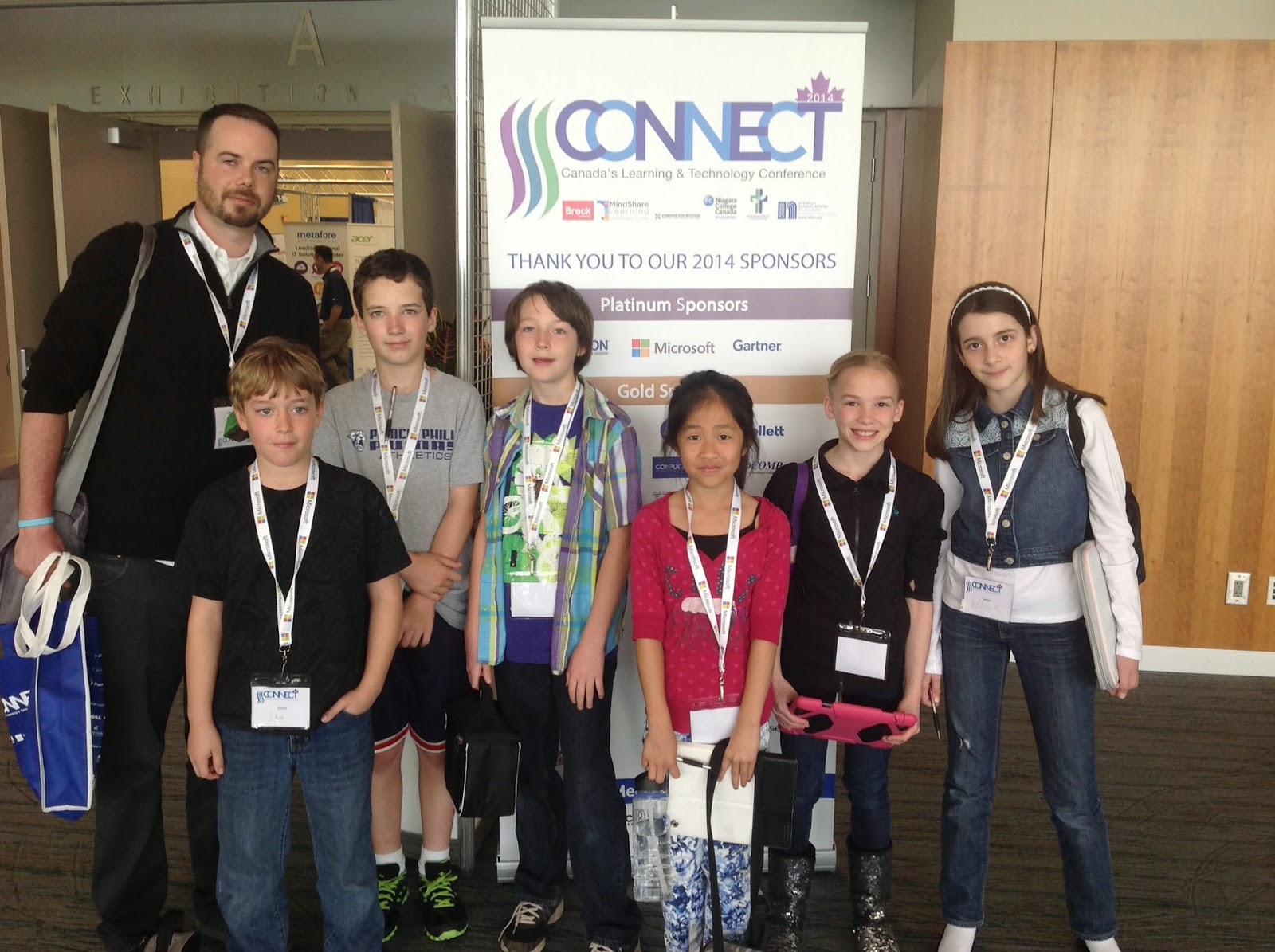
Friday, May 9, 2014

Connect 2014

Goal:  Present Minecraft at Connect 2014

Attendance:  Lee, Rob, 6 Students

Overview:

-  Presented a poster presentation at Connect 2014
-  Had 6 students teacher educator from across Ontario how to use Minecraft
-  All information available on this site.


http://engagewithminecraft.weebly.com


Friday, April 25, 2014

Co-Teach Minecraft

Goal:  To continue to Co-Teach minecraft unit with 5M

Attendance:  Lee Martin, Rob Dunlop

Overview:

-  Based on co-planning earlier in the year, we would be introducing this project and recording evidence of it success for the upcoming Connect Conference
-  due to complication with getting Minecraft on the computers this unit was delayed until now.
-  series of subtask we taught in the classroom to introduce the ideas of area and perimeter.
-  Also, student we given intro task to help them explore and create using mine craft using a scientific investigation approach


-  Success criteria was created by Lee
-  Students were brought into the lab and given their investigation


-  As students worked, Rob captured evidence on their work for website that was being create.
-  Green screen interview we conducted and made into video presented on the website


http://engagewithminecraft.weebly.com

Wednesday, March 26, 2014

Co-Construct Success Criteria

Goal:  Co-create success criteria for social studies lesson with 5Mac

Attendance:  Martine, Erica, Robert

Overview:

-  We started the lesson off with Mario interrupting the class to introduce the below letter to the class.


-  Used classes negative reaction to generate discussion about how we could change this decision.
-  Guided students into the idea of writing a letter
-  Discussed what the letter might look like
-  Student put into group to write letter
-  Posted, gallery walk
-  Used these lessons to create the gallery walk below


- Next lesson, we used this success criteria and the work they did the day before to teach a mini lesson on letter writing and organization, based on curriculum expectations.

Wednesday, February 12, 2014

5Mac Social studies and Success Criteria

Goal:  To co-create success criteria together in a social studies activity

Attendance:  Martine MacKenzie, Robert Dunlop, Erica Poor

Overview:

-  discussed where she was at with regards to her PD learning
-  said she was very interested in extending her learning regarding Success Criteria and Learning Goals
-  we looked at where she was at in each of her subject and the best fit to see this co-created with the class.
-  she wanted to focus on social studies so we look through the curriculum to decide which expectations to do.
-  we decided to use a cross curricular approach which will cover both Social Studies and English.
-  This was she could teach the social studies in French and the students could do letter writing in English.

-  Once we selected our curriculum expectations, we created a learning goal and unpacked our success criteria for practice.

See below

Learning Goal:  To write a formal letter to the government that effectively presents a
                              solution to an issue that affects them.


Requirements:
-  3 paragraphs
-  must be to government official
-  must have greeting/salutation
-  follows a template


Social Studies (B1.2, B1.3)
- realistic
-  specific
-  innovative/creatice
-  well thought out
-  measurable  ???
-  cost effective

Purpose/Organization (1.1 & 1.5)
- clear and concise
- rationale should be backed up with  
  evidence
- each paragraph has a specific purpose
- narrow focus


Day One: Hook Lesson (100 min.)
-  We will start co-teaching.  Interrupted by Mario
-  One week extension to school year for just us.
-  I’ll take over, past experience
-  What are we going to do?  Most effective means to communicate?
-   Select letter – What would our arguments be -  brainstorming.
-   Discuss what should be in the letter -  issue, how we can solve it. 
-   Discuss how this should be organized into graphs
-  Break into groups and write letter to present to Mr. Zeoli (time limit)

Day Two:  Set Up Success Criteria
-  Look back at examples and critique (effective critism) – Gallery walk
-  present learning goal to class
-  Unpack (Rob)


Day Three:  Mini Lesson
-  Format and structure of letter
-  Square
-  Each paragraph needs a specific purpose (multiple points)
-  Give another opportunity in groups.  Give them a topic or article, write a letter.  Perhaps in language.
-  Give them the purpose of the each paragraph  (Address issue, create a plan,
     implementation)


Day Four:  Evaluate letter using success criteria
-  each group will peer evaluate others groups using the set out success criteria.
-  Discuss with class
-  You set up and give out final assignment – Letter to government


Monday, February 3, 2014

Grade 7 Measurement Unit Planning

Goal: To backward design a measurement unit for a grade seven class.

Attendance:  Denise Ibey, Robert Dunlop

Overview:
-  Wanted to really focus unit off the curriculum and weed out unnecessary teaching-  Review curriculum
-  Decided to focus on measurement conversions and area of composite shapes and trapezoids.
-  Will focus on volume more in term three.

Here are the lessons/investigations that we created for this unit.

https://docs.google.com/file/d/0B1QTCzUprTwINEplX2gwbjFfeE0/edit


https://docs.google.com/file/d/0B1QTCzUprTwINTMzU1Z0OUtFb3M/edit


https://docs.google.com/file/d/0B1QTCzUprTwIcWwwVk1acjJtOEk/edit

Tuesday, January 14, 2014

8 English- Science Investigation

Goal:  To create a science lesson using the curriculum documents (outside of the text book).

Attendance:  Jake Allcock, Robert Dunlop

Overview: 

-  Looked a current program and how Jake is covering his material.
-  Wanted to make sure that all concepts were connecting to curriculum documents.
-  Noticed that document was not lining up directly too curriculum.
-  Discuss the importance of looking at the verbs in the curriculum to guide our instruction.
-  Decided to pick an expectation and create a lab based directly on a curriculum expectation.
-  This was the expectation that we choose.  Did not address this in text book.


-  We wanted to do something more hand on, away from the text book, so we decided to create a scientific investigation for this.
- We watched video on youtube and looked up online lessons
-  Check out to see what materials we had in the school
-  Then created this.


Name:______________________________
Density of a Liquid Investigation

Purpose: To build a hydrometer and explore the density with regards to liquids.

Materials: straw, clay, water, beaker, spoon, measuring, spoon

Procedure:

  1. Using the clay provided, seal off one end of the straw so that water is unable to seep through.

  1. Fill the graduated cylinder up to 200 ml using the water provided.

Note: The water will form an arc curve called a meniscus. Read your water level from the
bottom of this arc.

  1. Place your straw in the water, sealed side down. You want the open end of the straw no more than 2.5 cm from the top of the container. You will need to cut the straw and add enough weight in clay to allow the straw to stand straight up.

  1. Carefully remove your hydrometer from the water, pinching it where the water meets the air. Draw a red line to indicate the beginning water level (zero). Now that your hydrometer is calibrated for “pure” water, mark lines above and below this line that are 1mm apart using a different coloured marker.

Note: Each line above the red line will be noted at +1, each line below the red line will be noted
-1 (on the chart below).

  1. With the calibrated hydrometer out of the water, add 5 ml of salt to the water and stir until salt is dissolved. Place the hydrometer back into the beaker and observe and record the changes in level of the hydrometer on the chart below. Repeat these steps for the follow amounts of salt provided in the chart.

Grams of Salt Added
Change in Level
Observations
5


10


15


20


25


30


Guided Questions: Use the Particle Theory discussed in class to help you answer the questions
below.

  1. Explain your observations and why you think that this happened each time you added salt.
_________________________________________________________________
________________________________________________________________________________________________________________________________________________________________________________________________________________________________________________________________________________________________________________________________________________________________________

  1. Could you make connection from what you observed in this this experiment to something that
    you have experienced in your life?
________________________________________________________________________________________________________________________________________________________________________________________________________________________________________________________________________________________________
________________________________________________________________________________________________________________________________________________

If the experiment was to continue, eventually the salt would no longer dissolve into the water.
  1. Why do you think that this is? (Remember to use particle theory)
    ________________________________________________________________________________________________________________________________________________________________________________________________________________________________________________________________________________________________________________________________________________________________________________________________________________________
  1. If we were to boil the salt water in your experiment until all of the water was gone you would
    be left with salt in the beaker. Why? ( Remember to use particle theory)
____________________________________________________________________________________________________________________________________________________________________________________________________________________________________________________________________
__________________________________________________________________________________________________________________________________


Once we tried and completed this experiment.  We discuss how this would be assessed using a rubric that would be created off the success criteria.

I showed and explain the success criteria that Jack and I created and offer to set up for him in his classroom and he needed help


Tuesday, December 17, 2013

Minecraft Critical Thinking Task (Session 2)


Goal: To complete set up for Minecraft critical thinking task

Attendance: Lee Martin, Rob Dunlop

Overview:

- Reviewed additions made to procedures and guided questions.

- Solidified links to social studies curriculum (A. 2.3, A.3.4) and math curriculum. Confident that they are aligned effectively to culminating task.
 
Social Studies
         A2.3 analyse and construct maps as part of their investigations into interactions among and between First Nations and Europeans (e.g., thematic maps showing physical features that influenced settlement patterns, agricultural practices, or the habitat of animals that sustained the fur trade; historical maps that show First Nations territory at the time of contact or the expansion of New France
         A3.4 identify significant offices and institutions in New France (e.g., the seigneurial system; the Roman Catholic Church; the king, governor, bishop, and intendant; nuns, priests, missionaries), and describe their importance to settlers in New France “What effect did the seigneurial system have on the way land was divided and developed?”
Mathematics
        determine, through investigation using a variety of tools (e.g., concrete materials, dynamic geometry software, grid paper) and strategies (e.g., building arrays), the relationships between the length and width of a rectangle and its area and perimeter, and generalize to develop the formulas [i.e., Area = length x width; Perimeter = (2 x length) + (2 x width)];
        solve problems requiring the estimation and calculation of perimeters and areas of rectangles
        determine, through investigation, the relationship between capacity (i.e., the amount a container can hold) and volume (i.e., the amount of space taken up by an object), by comparing the volume of an object with the amount of liquid it can
        contain determine, through investigation using stacked congruent rectangular layers of concrete materials, the relationship between the height, the area of the base, and the volume of a rectangular prism, and generalize to develop the formula (i.e., Volume = area of base x height)

- Lee addressed concerns about giving students more guided practice.

- Decide to create a lead up assignment to give students practice, to work out any issues and to help build success criteria off of.

- After brainstorming, we decided to have student “Design Mr. Martin's Backyard”.

- We discussed our pedagogical approach to this assignment and agreed we would keep it very similar to culminating task. However, we would give less details as this assignment would become the basis of teaching perimeter, area and volume/capacity.

- Decided that we needed to extend the culminating task to include volume and capacity.

- Create the investigation for the “backyard planning”

- Developed and tweaked learning goal. Also, made predictions to what students would be able to come up with as success criteria.
 
Learning goal: To effectively demonstrate an understanding of perimeter, area and volume of
                          rectangles and cubes using Minecraft.
Unpack
- Proper Units
- Correct Forumlas
- Clear communication of math
- Variety of dimensions
- Guide Questions (Relationships)
- Accuracy
- Labels

- Decided that this would be tweaked more after the first assignment and that we would wait to make rubric to make it more authentic to the students with regards to their wording and ideas.

Next Steps:

- To get MinecraftEDU installed in the lab (waiting on a response)

- Lee to create graphic organizers for both investigations

- Set up 'World' in Minecraft MOD

MinecraftEDU


Goal: To create a critical challenge using Minecraft to teach measurement expectations

Attendance: Lee Martin, Rob Dunlop, Brad Mayhew

Overview:

- Lee justified the significance of using Minecraft in the classroom. Showed an online example that motivated him to undertake this initiative.


- Lee explained the set up for MindcraftEDU and the development of 'Mods'.

- Through discussion, we decided we wanted to create a cross curricular (math/social science) critical thinking task. We decided to create the seigneurial system in New France as an extension to the material being covered in social science.

- To get a better understanding of Minecraft, a grade 5 students came to answer several questions and demonstrate some of the tools used in the program.

- Based on what we learned from the student, we decided that we would focus on the measurement unit. In particular, investigations involving perimeter and area of rectangles and squares.

- We discussed the pedagogical approach we wanted to use. We decided to use the scientific investigation approach for our culminating assignment.

- We developed the purpose and materials and worked on developing the procedures.  As well, we started to explore different guided questions.
 
-  Click here to see the rough draft for the scientific investigation.


Next steps:
-  to further develop the investigation, create our learning goals and success criteria and to discuss how we would set up this culminating task

Sunday, November 24, 2013

Science Report Success Criteria (8FI)

Goal:  To transfer success criteria to anchor chart and rubric

Attendance:  Jack, Rob

-  Discussed co-construction of success criteria
-  Discussed the important of placement in room and the fact that it is a 'live' document, that needs to
   change as labs evolve.
-  Looked a different ways to layout the anchor chart
-  Jack had a creative idea for design
-  Decided to make the first anchor chart in English and then transfer to French one the students fully understand the criteria
-  Created the anchor chart (rough copy), Jack wants to create a final good copy.


-  Then worked on transferring success criteria to rubric
-  Discussed checklist as a method to help with feedback
-  Discussed how each lab needs to link to curriculum and that is what they are being assessed on.
-  Finished Rubric (below)


https://docs.google.com/file/d/0B1QTCzUprTwIR0lHVnpkT256QWc/edit

-  Discussed how to model use of success criteria in large group and small group instruction

Next Steps:
-  He will model how to write up a lab using success criteria
-  He will have students use this lab to peer assess other groups work
-  We will meet up to discuss how this went and refine if necessary

Co-Teach Success Criteria (8FI)

Focus:  To co-create success criteria for science lab report through co-teaching 

Attendance:  Jack, Rob, Brad Mario

-  Opened class discussing the purpose of working together to create this criteria
-  Showed a video to engage students in the lesson.  See video below.


-  Related the video to making observations and tied that into how that relates to a science lab.
-  Pulled out different components of a science lab (purpose, hypothesis, materials, procedure, observations, results, conclusion).
-  Asked students to put on their 'teacher hats' and determine which of the above they felt would be the best to assess to demonstrate understanding of the concepts being investigated. 
-  Student selected Observations, Results and Conclusion, which aligned perfectly with projected learning goal.
-  Posted Learning Goal:  To effectively use scientific observations, during an experiment, to analyze results and develop a strong conclusion.
- Through looking at examples and discussion about previous two labs, we co-constructed the success criteria.  We focused on observations, results and conclusion.
-  At the end, we came up with 3 success criteria, unpacked on the Smartboard.


Next Steps:
-  Transfer success criteria from Smart Notebook to chart paper (anchor chart)
-  Create a rubric using the success criteria
-  Model use of success criteria in a lab


Wednesday, November 6, 2013

Science (Grade 8 PI)

Focus-  Incorporating Learning Goals and Success Criteria in science

Attendance:  Jack and Rob

Overview:

  • Met with high school science teacher to discuss current expectations and format for lab reports.
  • They do not do formal reports, however they have student focus on observations, results and conclusions.
  • Helped us get a clearer understanding of these three elements of a report and gave example of what they are looking for and how they assess it.
  • Also, talked about the rationale behind this.  Focus more on the skill of analysing the data and application of information.
  • Revisited our past learning goal and success criteria and realized that it needed to be changed based on new information and understanding.  Discussed how this need to be a live document that changes as more information is presented. 
  • Decided that we should reword our learning goal to include observations, results and conclusions.
  • Decided to backward design our success criteria based on what it is we expect to see.  
  • Discussed the different between observations and results and developed specific success criteria and requirements for each.
  • As well, looked a example of good results and selected the aspects that we thought we important and added them to our success criteria and learning goals.
  • Once happy with this, we solidified our choice of labs and agreed to co-teach next day 3 to two different classes and then debrief afterwards.  
  • He wanted to know how this could fit into math as well.  We discussed creating learning goals and success criteria for communication of mathematical ideas and for problem solving.

Next Step:  
  • Jack will administer lab diagnostic prior to day 3
  • We will look at this together to see how it fits with our success criteria and potentially make adjustments
  • Co-teach lesson on developing success criteria with the students 
  • Create an anchor chart with examples that can be used to reference for other labs throughout this unit and others.

Learning Goals and Success Criteria Brainstorm

Monday, November 4, 2013

Science (Grade 8 FI)

Focus:  Incorporating Learning Goals and Success Criteria into the Science Curriculum

Attendance:  Jack, Rob

Overview

  • Decided we wanted to meaningfully connect learning goals and success criteria into science lessons
  • Discussed current unit (Substances) and where he was at in this unit.
  • Cross referenced material he was using with curriculum to see where we should go next
  • Decided it would be helpful to have Success Criteria for lab write ups.
  • Wanted to ensure consistency with high school
  • Contacted Anthony Siriani at AN Myer to create high school liaison
  • Discussed how it would be important to separate success criteria from requirements, especially in lab reports
  • Anthony return call and filled us in on how it looks in high school.  Main focus on Observations and Conclusion.  Moved away from formal lab report write ups.
  • With this information, decided that this would be our focus as well.  We wanted to create success criteria for just the observations and the conclusions.
  • Consulted Smarter Science Resource for ideas.
  • Developed a learning goal:  To effectively use observations to support or reject hypothesis into a strong conclusion.  
  • Brainstormed what a good observation should look like using example reports (ie.  Different ways of presenting data, accuracy, and detail)
  • Brainstormed what a strong conclusion looks like (present most important information, clear explanation, relate to why this is important).
  • Pulled apart requirements for each.  
  • Discussed how we plan to teach this.  Decided to give them a lab to do with minimal guidance as a diagnostic.  Use these reports (chart paper), to help pull out some of the success criteria and guide them towards creating stronger observations and conclusions.  Have then revisit their lab using the success criteria and use feedback to improve it.  Then do another lab that will allow them to practice this again.  We were thinking for using an online lab to have students do this independently. 
Next Steps:
  • To connect with high school teacher on Wednesday to get a clearer picture of what this looks like in high school
  • Select a lab to complete as a diagnostic and one to complete as a practice.

Rough Draft
Grade Eight Science
Lab Assessment

Learning Goal: To effectively use scientific observations, during an experiment, to develop a strong
conclusion.

Observations:
Success Criteria: Able to select the most appropriate way of displaying data recorded
Able to accurately collect and record data
Able to make specific and detailed observations throughout lab
Requirements: Must present all finding from experiment
Must carefully following the procedures in order

Conclusions:
Success Criteria: Able to clearly explain understanding of the main findings of the lab
Able to pull out the most important findings from the lab
Able to relate importance of the finding to real world situations

Requirements: Must accept/refute hypothesis
Must create a summary of findings
Must answer guided Questions


Thursday, October 24, 2013

Grade 7 (French Immersion) Updated inquiry frameword

Overall Arching Inquiry Question
Who should we help?  Equitable distribution.

Overarching Critical Challenge:
The UN has created a sustainability fund for a Natural Resources Issue. Create a Proposal and a sustainable action plan.
 
INQUIRY SUB TASKS
 
Background Knowledge  (Hook:  Enbridge Article)
 - Natural Resources (B3. Definition, sustainable: first part of definition)
- Natural Resources Issues (definition- examples)
- Factors <---------------------------------------------> Natural Resources
                              Impact and significance
-  Who is involved?  Who's affected? Who benefits?  Pro/cons purpose?
  • Political, Social, Economic, Geographic (environmental)
 Application:    (Japan Article)
Develop a list of natural resources (Canada and the World)
- News articles, pictures, videos: Identify the issues and the factors
                -  highlight impact in four factors, transfer to four square)
-  Connect to Criteria (Magnitude, Scope, Duration)
-  Questions-  Why does this matter?  Who Cares?
- The rank (good, better, best)

Not sustainable                                                                      Sustainable
                                          Continuum
       I--------------------------------------------------------------------------I

  • how many, how much, depth, gravity, longevity, area,
  • in end plot on the line (social, economic, political, geographic)

Inquiry
      -  mini-lessons  (paraphrasing, evaluating sources, mapping analysis, etc...)
      -  Teaching Critical Thinking
      -  Process of Inquiry
      -  Action Plan


Grade 7 (FI)


TFL- October 23rd, 2013

In attendance: Melissa, Brad, Mario, Danny, Kevin, Stephen, Rob

Objective: Completion of Critical Inquiry Framework

- Review of what we discussed last session.
- Looked at TC2 lesson “Consider Significance” to help with criteria for Impact (discussed in
   previous session)
- Discussed having the three criteria (magnitude, scope of impact, duration) into all four areas
  (social, political, economic, geographic)
- Discussed the definition of sustainability- tried to determine if we should add in equity into the
   definition.
- Presented specific natural resources issues around the world.
- Stephen shared Fishing in Japan, Forest fire in Montreal
- Brad shared oil sands development in Alberta
- Rob shared forestry issues in Brazil, UN sustainability document
- Danny discussed giving the Aboriginal Perspective and how to create a reasonable
   sustainability plan.
- Kevin shared Embridge Oil pipeline affected rivers (aboriginal perspective),
- Melissa shared Yanomami (sample from curriculum). Presented from TC2 source docs

- Decided to use Enbridge Idea (local) to model Background knowledge
- Decided to use larger Issue (Japan: Nuclear affect on fishing) to get students to apply their
  learning
- Worked on connecting four factors to criteria using Japan as an example.
- Focus question to pull out criteria - Why does this event matter? Who cares?
- Discussed time line- Around 3rd week of November
- Also, discussed type of teaching (team, independent, Co-teaching)
- Tools for Thought introduced – Thinking Strategies.

Inquiry
- Mini- Lessons
- Teaching Critical Thinking
- Action Plan

- Discussed the importance of mini lesson throughout the inquiry part. Avoid just letting them go.

Next Steps:
Grade seven team will start unit mid-November and work on background knowledge.
At that point they will decide if we need to meet and readjust or if they will just
continue through application phase. We will need to meet to go through the Inquiry
and action plan phase.

Here is the Delicious Bookmarking site that we talked about starting.


Tuesday, October 22, 2013

Grade Seven (FI)

  • started looking at progress on critical challenge diagnostic
  • going to add into science and geography lessons, upcoming novel study
  • work still to be assessed
  • Discussed overarching tasks and critical inquiry question
  • Discussion on whether to limit their choice of location and issue
  • Looked at skills we wanted students to develop in order to help us decide if we want to limit topic choice.
  • Discussed goals for this overall session: To be able of transfer this framework to other units and curriculum
-  Developed framing below.


Overarching Critical Challenge:
The UN has created a sustainability fund for a Natural Resources Issue. Create a Proposal and a sustainable action plan.
 
INQUIRY SUB TASKS
 
Background Knowledge
 - Natural Resources (B3. Definition, sustainable)
- Natural Resources Issues (definition- examples)
- Factors <---------------------------------------------> Natural Resources
                              Impact and significance
  • Political, Social, Economic, Geographic (environmental)
 Application:   

Develop a list of natural resources (Canada and the World)
- News articles, pictures, videos: Identify the issues and the factors
- Significance of sustainability
- The rank (good, better, best)

Not sustainable                                                                      Sustainable
                                          Continuum
- I--------------------------------------------------------------------------I

  • how many, how much, depth, gravity, longevity, area,
  • in end plot on the line (social, economic, political, geographic)
Next Steps:
-  Bring in specific examples of locations that are struggling with sustaining a natural resources
-  Think about what strategies we will focus on teaching in the final stage of the inquiry
-  Finish creating the framework so that it is ready to be implemented into the classroom

Tuesday, October 15, 2013

Focus- Integrating Critical Inquiry Throughout the Curriculum (Specifically Geography)

Attendance- Kevin, Stephen, Melissa, Mario, Brad, Rob

Overview

  • Started the session discussing and trying to refine "If then" statement
  • Looked at diagnostic (Explain the Image) as a group to see where they were strong and where they needed more support.
  • Overall findings, were that students were usually making inferences first, then trying to support with observations.  Several groups still mixing up the two concepts. 
  • We agreed that it would be good to have a follow up lesson where we just focused on Observations.  From there, they could build upon at and add in the inferences.  As well, we felt that they would need  more work on how to pull both of them together into an effective summary.
  • At this point, we decided to determine where we should go based on what we observed during the lesson and in the activity.
  • We agreed that we needed more clarification on the difference between critical literacy, inquiry and thinking.  We decided that this would be a good time to share our definitions based on the article, Exploring Inquiry.  We agreed that inquiry in more of a framework with an overarching question that drives the instruction.  As well, we discussed that their is a main inquiry task that students are working towards.  We also discussed that there needs to be a variety of smaller inquiries that lead them to developing the knowledge and skills to answer the overarching question.
  • Looked at grade 4 example of critical inquiry unit.
  • Decided that our over arching question would be; Which natural resource is most endangers human existence?  Need to tweak this.
  • Overarching Critical Challenge: The UN has created a sustainability fund for natural resources. Create a proposal to convince them to fund your issue.  (Take the perspective of a representative of a specific country with a resource issue)
Next Steps:
  • Teachers will continue their observation/inferences lessons.  Focussing on making clearer, observations.  They will complete the lesson using new pictures.  Breaking images up into sections. 
  • Will try to think of more ideas to go towards the critical inquiry over arching question.